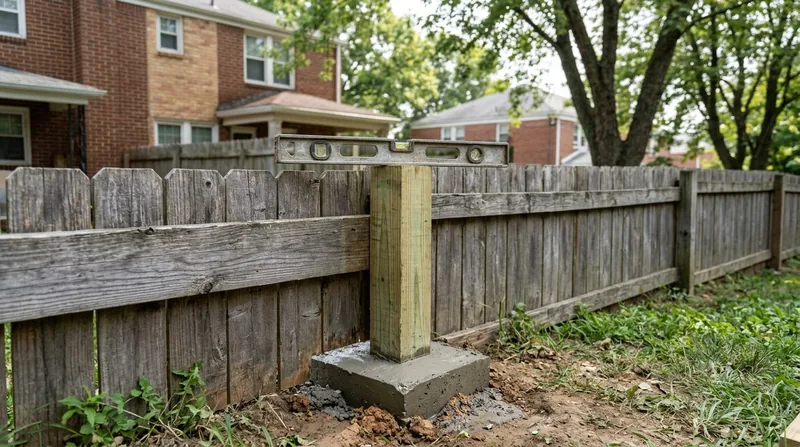




Washington's dense red clay and freeze-thaw winters are brutal on fence posts. The ground swells when it freezes, heaves posts out of plumb, and stays saturated enough to rot wood at the ground line, which is why most fences in Capitol Hill, Petworth, Cleveland Park and Anacostia lean or fail long before the rails and pickets wear out. Fence post repair in Washington almost always means resetting or replacing the posts themselves while saving the rest of your fence, a repair-first approach that costs far less than a full replacement. We dig out the bad post, set a new one in fresh concrete, plumb it true, and brace it to hold while the concrete cures. The result is a straight fence that will stand for decades, not a new fence at new-fence prices.
Why Fence Posts Fail in Washington: Red Clay, Frost, and Water
Washington sits on dense red clay that holds water longer than any other soil type. In winter, that water freezes and expands, pushing posts up and out of alignment. In summer and after heavy rain, the same clay stays saturated at the ground line, where wood posts absorb moisture and rot from the inside out. Cedar and pressure-treated pine both fail this way, not because they are poor wood, but because the clay environment is relentless. Posts set only in tamped soil, without concrete, heave and sink repeatedly until they split or lean. Even posts set in concrete can fail if the concrete is shallow, if the post was not plumb when set, or if water pools against the concrete collar and wicks up into the wood.
- Freeze-thaw cycles in winter push posts up and out of plumb, creating visible lean and stress on rails and pickets.
- Saturated clay at the ground line rots wood posts at the base, weakening them until they snap or sag under the weight of the fence.
- Poor initial installation, such as shallow concrete or posts set in clay without concrete, guarantees early failure in Washington's climate.
- Water pooling around the concrete collar allows moisture to wick up into the wood, extending rot even in a well-set post.
All of these failures are preventable with proper post reset or replacement in deep, well-drained concrete and correct plumbing from the start.
Key info: In Bloomingdale, Shaw, and other neighborhoods with narrow backyards and alley fences, a leaning post often signals water damage in the clay beneath. Waiting to repair it spreads the problem to adjacent posts and can eventually collapse a whole section of fence. Early repair saves the fence and the cost of replacing multiple posts later.
How We Repair and Replace Fence Posts in Washington: Step by Step
Fence post repair and replacement in Washington requires digging below the frost line, removing the damaged post and old concrete if necessary, and setting a new post in fresh concrete that will hold through the next twenty winters. We start with a utility locate (required by law before any digging in the District), then remove the bad post, dig the hole deep enough to sit below the frost line (typically 42 inches in Washington), backfill with gravel for drainage, set the post plumb with bracing, and pour concrete around it. The concrete cures for 24 to 48 hours before we remove the braces. The result is a post that will not heave, rot, or lean.
- We call for a utility locate to mark underground lines and confirm it is safe to dig.
- We remove the leaning or rotted post and excavate old concrete if it is shallow or damaged.
- We dig a new hole below the frost line (42 inches minimum in Washington) and backfill the bottom 6 inches with gravel for drainage.
- We set the new post plumb using a level and temporary bracing to hold it square while concrete cures.
- We pour concrete around the post, sloping it away from the wood to shed water and prevent rot at the collar.
- We remove braces after 24 to 48 hours and reconnect rails and pickets to the new post.
This process saves the fence and takes 2 to 3 days from start to finish, depending on how many posts need work and how quickly the concrete cures.
Local example: A six-foot cedar privacy fence along a rear alley in Spring Valley had two posts heaving and one starting to rot at the base. Rather than replace the entire 40-foot fence, we reset the two heaving posts and replaced the third. The fence is now straight and will last another 25 years. Total cost was a fraction of a new fence, and the homeowner kept the original cedar rails and pickets.
Fence Post Repair Methods: Repair, Reset, or Replace
| Approach | Description | Best for |
|---|---|---|
| Reset in concrete | Remove the post, dig below frost line, reset it plumb in fresh concrete with proper drainage slope. | Posts that are sound but heaving or leaning due to frost or poor initial installation. |
| Replace with new post | Remove the damaged post entirely and install a new pressure-treated or cedar post set in concrete below frost line. | Posts rotted at the base, cracked, split, or too far gone to reset safely. |
| Concrete repair and brace | Pour additional concrete around a shallow or damaged concrete collar and install anti-sag bracing between posts. | Posts that are still sound but leaning slightly due to settling or inadequate initial concrete depth. |
| Rotted fence post repair with sister post | Install a new post alongside the damaged one, transfer the load of rails and pickets to it, then remove or leave the old post in place. | Posts too rotted to be safe but where excavation or removal would damage the fence structure irreparably. |
Each method has a cost and timeline. We assess the post on site and recommend the approach that saves the most fence and costs the least money.
Fence Post Repair and Replacement Cost in Washington: What to Expect
Fence post repair in Washington starts at around $450 for a single post reset or replacement, including excavation, concrete, and labor. The final cost depends on how many posts need work, whether you are replacing or resetting, the depth of frost line, the condition of the existing concrete, and whether the rails and pickets are still sound or need repair as well. A property with two heaving posts in a rear alley fence might run $800 to $1,200. A full fence with three or four failing posts could run $1,800 to $2,500. See our full pricing overview for a detailed breakdown by job type.
The best way to know what your repair will cost is to get a free, no-obligation estimate. We will come out, assess the damage, measure the posts, and give you a realistic number based on what you actually need, not what we think we can sell you. Many homeowners are surprised to learn that repairing posts costs far less than replacing the entire fence, and that the repair will last just as long.
Factors that affect the final price include the number of posts needing work, whether concrete must be broken out and removed before a new post can be set, the depth of the hole (frost line in Washington is typically 42 inches), whether the post is in an alley with limited access, and whether you need additional fence repair to rails, pickets, or caps while we are there. If your fence has multiple damage points, we often recommend tackling them all at once to avoid mobilization costs and to ensure the fence is truly stable.
Fence Post Repair and Replacement Near Me: What Washington Homeowners Should Know When Hiring
Fence licensing in Washington is set by the District of Columbia and varies by project scope and jurisdiction. Projects above a certain dollar threshold may require a licensed general contractor, but fence post repair and replacement typically fall below that threshold for residential work. The best protection is to hire a contractor who is fully insured with general liability and workers' compensation coverage and can provide a certificate of insurance on request. We carry full insurance and can document it before work begins.
When you call contractors for estimates, ask for references from recent fence work in your neighborhood, check that they understand Washington's clay soil and frost line, and confirm they will call for a utility locate before digging. Ask whether they set posts in concrete below the frost line as standard practice, not as an upgrade. Many cheap estimates skip proper concrete depth or skip the concrete altogether, which is why those fences fail again in two or three years. Get at least two estimates so you can compare approach and price. Call us for a free estimate and we will walk you through exactly what we find and why.
If your fence is in a historic district, a master-planned community with an HOA, or on a corner lot with sight-distance rules, check your local building department or HOA architectural guidelines before work begins. Permits are sometimes required and sometimes not, depending on your address and the scope of the repair. We can help you understand what applies to your property, but the final word comes from your local building department.
Fence Post Repair & Replacement in Washington: Pricing Guide
| Service | Price | Details |
|---|---|---|
| Single post reset or replacement | Starting at $450 | Includes excavation below frost line, concrete, plumbing, and labor for one post in accessible location |
| Two to three posts | Starting at $850 | Bulk efficiency on material and labor when multiple posts are reset or replaced in the same fence run |
| Four or more posts, or rotted fence post repair with structural complications | On estimate | Large-scale jobs, posts in tight alleys, or extensive concrete removal need site assessment before pricing |
| Anti-sag bracing or concrete collar repair | Starting at $200 | Reinforcement of existing posts that are still sound but leaning slightly or settling unevenly |
| Utility locate and permit coordination | Included | We call for utility locate before digging and handle coordination with District or local requirements |
| Estimate | Free | No obligation, response within 24 hours at (771) 246-2846, includes assessment and written quote |
Indicative pricing, the exact cost depends on square footage, finish, and site access. Free personalized estimate within 24h at (771) 246-2846.


