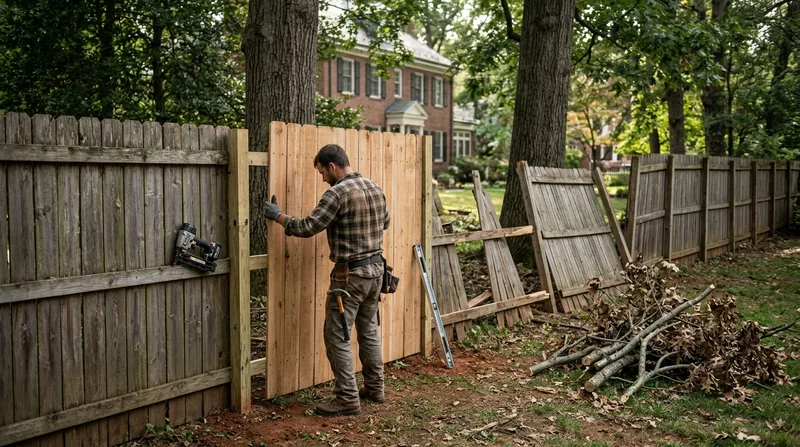




Summer derechos, tropical storm remnants, and heavy wet snow leave Washington fences flattened across rear alleys and side yards every few years. When a storm damage fence repair becomes urgent, the goal is clear: rebuild the same line, restore the look, and do it stronger. Washington's dense Victorian rowhouses on Capitol Hill and Shaw, brick colonials in Chevy Chase and Cleveland Park, and post-war duplexes east of the Anacostia River all depend on fences to define property, contain yards, and screen from the street. Cedar and pressure-treated pine privacy fences along rear alleys, wrought iron and steel pickets in front, and galvanized chain link on side lots all fail the same way when a mature oak or tulip poplar comes down or wind rakes across exposed sections. We assess the damage, document it with photos and a written estimate to help your insurance claim, and rebuild fast without the delay of a full replacement.
Why Storm Damage Fence Repair Matters in Washington's Neighborhoods
Washington's tree canopy is thick and mature. Oaks, tulip poplars, elms, maples, and crape myrtles shade the streets and yards, but they also shed limbs in wind and carry full crowns of wet snow in winter. When a branch or tree comes down on a fence, the damage is often localized to one or two sections. The posts may snap, the rails split, or the boards crack and buckle. A fence blew down in a storm is not always a total loss. Posts set in concrete on solid footings can be replaced in place; rails and boards can be spliced or renewed on the same line. Catching the damage early and getting it documented protects your claim and keeps the repair cost lower than waiting for rot to spread from the ground line or for the fence to lean further.
- Document damage with photos and measurements before cleanup or debris removal.
- Contact your homeowner's insurance within 48 hours to report the loss and request a claim number.
- Get a written estimate from a fence contractor to attach to your claim.
- Check your policy for deductibles and coverage limits on fence damage.
- Verify that setback and height rules in your neighborhood allow the repair on the same line.
Fast action protects your property line and keeps neighbors from questioning the boundary after the old fence is gone.
Key info: Washington's dense clay soil and freeze-thaw winters heave fence posts upward and rot them at the ground line. A storm that topples a fence often reveals posts that were already failing. Replacing them with new posts set deeper in concrete and tamped firm prevents the same failure in the next storm.
For more detail on post failure and repair, see our fence post repair and replacement page.
The District of Columbia and surrounding counties have different rules on fence height, setback, and material. Your local building department can confirm whether your repair needs a permit. Many repairs do not, but it is worth a phone call before you start. See your city or county building department website for details.
How We Handle Storm Damage Fence Repair in Washington
After a storm, the first step is a damage assessment. We inspect the fence from end to end, identify which sections are damaged and which are sound, measure the posts and rails, and photograph the site. We assess whether posts are set in concrete or tamped earth, whether the damage is to the posts, rails, or boards, and whether repair is possible or replacement is the better choice. We then provide a written estimate with a photo record that you can submit to your insurance company. If you approve the work, we schedule the repair and start within days, not weeks.
- We visit your property and walk the entire fence line to identify damage.
- We photograph each damaged section and measure the posts and rails.
- We provide a written estimate with photos attached for your insurance claim.
- We remove fallen trees or limbs that are blocking the fence or making repair unsafe.
- We replace broken posts in place, using the same depth and concrete setting to prevent future heave.
- We repair or replace rails and boards to match the existing fence height and line.
- We rebuild the fence to the same appearance and property line as before the storm.
The repair is complete when the fence stands plumb, the rails are level, and the line is straight.
Example: A 40-foot cedar privacy fence along an alley in Petworth takes a limb from a mature oak. Two sections of boards are cracked and one post is split at the base. The other sections and posts are sound. We replace the broken post and boards, splice the rails where needed, and rebuild those two sections. The fence line is restored in one day, and the repair costs a fraction of replacing the entire 40-foot run.
For questions about general fence repair beyond storm damage, visit our repair page.
| Repair Approach | When to Use It | Best Outcome |
|---|---|---|
| Post replacement in place | Post is cracked, split, or leaning; rails and boards are sound. | Fence stands plumb and level; property line is preserved; cost is 40-60% of full replacement. |
| Rail and board repair | Boards are cracked or split; posts and rails are intact. | Damaged boards are removed and new ones installed; fence height and appearance are restored; posts remain in place. |
| Section replacement | Multiple posts and boards in a 6- to 10-foot section are damaged beyond repair. | The damaged section is removed and rebuilt to match existing fence; adjacent sections remain in place; line is continuous and plumb. |
| Full replacement | More than 50% of the fence is damaged or posts are rotted throughout the line. | Entire fence is removed and rebuilt new; posts are set deeper and in concrete; fence is stronger and lasts longer. |
Storm Damage Fence Repair Cost in Washington: What to Expect
The cost of a storm damage fence repair depends on what failed, how much of the fence is affected, and whether the posts can be reused or must be replaced. A free damage assessment is the starting point. We visit your property, inspect the fence, and provide a written estimate with photos. From there, you know what the repair will cost and can submit it to your insurance company.
Posts that are set in concrete and are not cracked or split can often be reused. If the post is solid but the board or rail is damaged, you pay only for the board or rail and labor to install it. If the post is split or leaning, it must be removed and a new one set in its place, which costs more but is still far less than replacing the entire fence. Access matters too. A fence in an alley with a gate costs less to reach than one on a steep lot or behind a building. Cedar and treated pine are less expensive than vinyl or ornamental metal, and a simple privacy fence costs less than a board-on-board or stepped installation on a hillside.
Getting two or three estimates from different contractors is smart. Each will inspect the fence differently and may recommend different approaches. Comparing the estimates helps you understand what is actually needed and what the market rate is in your neighborhood. See our pricing page for more detail on costs by material and scope.
What to Look for When Hiring a Fence Contractor Near Me in Washington
Storm damage brings urgency, and urgency can lead to poor choices. A contractor who shows up the same day with a verbal estimate and pressure to start work is often not the best option. Take time to vet the contractor, even in a storm. Ask for references from recent storm repairs in your neighborhood. Call those references and ask whether the repair held, whether the fence looks right, and whether the contractor cleaned up afterward. Confirm that the contractor carries general liability and workers' compensation insurance and can provide a certificate of insurance on request. Ask how fence repair and installation are regulated in your jurisdiction. In Washington, DC and surrounding counties, fence height, setback, and material rules vary by jurisdiction and are set by local code and zoning. Some repairs require a permit, others do not. Your contractor should know the rules for your address and should verify them with the building department before starting work. If you live in an HOA community, check your architectural guidelines. Many HOAs restrict fence height, material, and color, and a repair that does not match those rules can be ordered torn down. Finally, get a detailed written estimate that breaks down labor, materials, and the scope of work. A one-line estimate is not enough. For a free estimate and to discuss your specific repair, contact us at (771) 246-2846.
- Verify the contractor carries general liability and workers' compensation insurance with a certificate available on request.
- Ask for references from at least two recent storm repair jobs in Washington.
- Check your local building department website to learn whether your repair needs a permit.
- Review your HOA architectural guidelines if you live in a master-planned community.
- Get a written estimate that lists labor, materials, and the scope of work in detail.
- Confirm that the contractor will remove debris and clean up the site when the work is done.
Hiring the right contractor saves money, protects your property, and ensures the repair is done right the first time.
Storm Damage Fence Repair in Washington: Pricing Guide
| Service | Price | Details |
|---|---|---|
| Damage assessment and written estimate | Free | We inspect the entire fence, photograph damage, measure posts and rails, and provide a detailed written estimate with photos for your insurance claim |
| Post replacement in place | Starting at $350 per post | Includes removal of damaged post, new post set in concrete, and reinstallation of existing rails and boards on the same line |
| Board and rail repair or replacement | Starting at $45 per linear foot | Cracked or split boards removed and new boards installed to match existing fence height, material, and appearance on same posts |
| Section replacement (6 to 10 feet) | Starting at $600 | Damaged section removed, new posts set in concrete, new rails and boards installed to match existing fence line and style |
| Full fence replacement | On estimate | Required when more than 50 percent of fence is damaged or posts are rotted throughout; site visit and inspection needed before pricing |
| Travel and estimate | Included | No separate mileage fee or call-out charge in Washington and surrounding areas; free estimate response within 24 hours |
Indicative pricing, the exact cost depends on square footage, finish, and site access. Free personalized estimate within 24h at (771) 246-2846.


