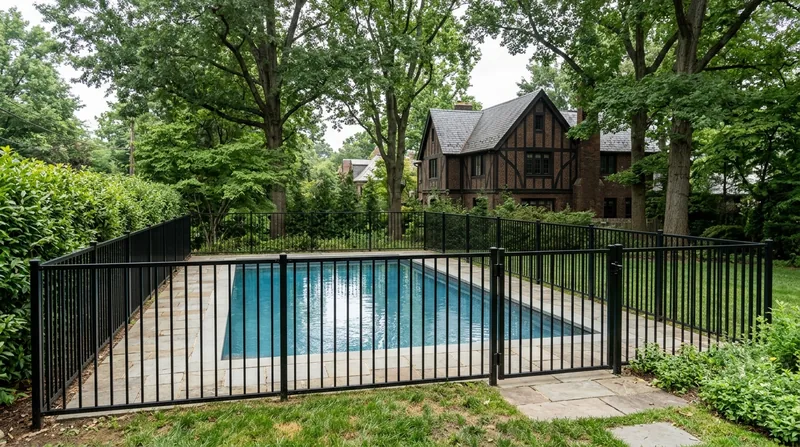




Washington's narrow rowhouse backyards and the few detached homes with pools face a specific challenge: pool fence installation must work within tight urban lots, navigate freeze-thaw damage to posts set in dense red clay, and meet the pool barrier code that applies at your address. A self-closing, self-latching gate that lines up after winter heave, posts set deep enough to hold, and aluminum or mesh that won't rot at the ground line are not luxuries in this climate, they're the difference between a barrier that works and one that fails when you need it most. Washington Fence installs aluminum, mesh, and glass pool barriers built to code, and we walk the requirements with you before a single post is set.
Why Pool Barriers Matter in Washington's Dense Urban Environment
Pool barrier code exists because drowning is silent and fast. In Washington, where many homes sit on small lots with pools tucked into rear yards bounded by alley fences, a removable pool fence or permanent barrier often becomes the critical layer between a child and open water. The code is not optional, and it is not one-size-fits-all: it depends on your lot configuration, the pool type, the proximity of doors and windows, and whether the barrier must also serve as a rear-lot boundary fence.
- Pool barriers must prevent unintended entry by young children and are inspected by the authority having jurisdiction before the pool can be used.
- A self-closing pool gate must latch automatically, and the latch must align correctly even after winter frost heave pushes posts out of plumb.
- Aluminum and mesh materials resist rot at the ground line better than wood, which matters in Washington's wet clay and humid summers.
- Post spacing, gate hardware, and latch force are all specified in code and vary by jurisdiction within Greater Washington.
This is why we verify the exact requirements for your address before we quote and install.
Key info: The District of Columbia and each county in the Washington area enforce different pool barrier standards. A barrier that meets code in one jurisdiction may not meet it in another. We confirm your local requirement and design the barrier to pass inspection on the first walk-through.
For a full overview of pool safety regulations, see the District of Columbia Department of Energy and Environment, which oversees pool and barrier codes in the District.
How We Install Pool Fences in Washington: A Step-by-Step Process
A pool barrier is not a fence you can eyeball and build. Every measurement, post depth, gate swing, and latch geometry must be right, or the barrier fails inspection. Our process starts with your address, the code that governs it, and a walk of the site with you to understand the pool layout, existing fencing, and any obstacles like utility lines or mature tree roots.
- We confirm the pool barrier code for your specific address and jurisdiction, because requirements differ across Washington.
- We call 811 for a utility locate and mark all buried lines before we dig any post holes.
- We set posts in concrete to the depth required by code, ensuring the post stays plumb through freeze-thaw cycles.
- We install the gate with self-closing and self-latching hardware, then test the latch alignment and closing force on site.
- We confirm all measurements, spacing, and hardware height with the code requirements and walk you through the final barrier before you call for inspection.
This methodical approach means fewer surprises when the inspector arrives, and a barrier that actually works when you need it.
Example: A Capitol Hill rowhouse with a small rear yard pool needed a mesh barrier. The alley fence was only 4 feet tall and sat on shallow posts heaved by winter frost. We set new posts 3 feet deep in concrete, installed 5-foot mesh, and added a self-closing gate with a heavy-duty latch. The barrier passed inspection and has held tight through two winters of freeze-thaw cycles.
Learn more about our gate installation and repair services, which include the specialized hardware pool gates require.
Pool Barrier Materials: Aluminum, Mesh, and Glass
| Material | Description | Best for Washington Homes |
|---|---|---|
| Aluminum | Lightweight, powder-coated to resist rust, posts set in concrete, slat or picket style, lasts 15-20 years in Washington's climate. | Detached houses with room for a traditional fence look; holds up well in wet clay and humid summers. |
| Mesh Pool Fence | Removable or permanent, high-visibility mesh on aluminum frame, self-closing gate, can be taken down when pool is not in use. | Small urban lots and rowhouse yards where a permanent fence is not practical; mesh does not trap wind or collect snow load. |
| Glass | Frameless or aluminum-framed tempered glass, requires careful post spacing and gate hardware, premium cost, unobstructed view. | High-end homes in Chevy Chase DC or Spring Valley where sight lines matter; glass does not rot but requires regular cleaning in humid air. |
| Combination Barrier | Existing rear fence plus mesh or aluminum gate, reuses the alley fence as part of the barrier, reduces new material cost. | Capitol Hill and other rowhouse neighborhoods where the alley fence already meets height and spacing code; saves cost and disruption. |
Each material has trade-offs in cost, maintenance, and how it sits in a Washington backyard. We help you pick the one that meets code, fits your lot, and works with your budget.
Pool Fence Installation Cost in Washington: What to Expect
Pool barrier cost in Washington starts at $34 per linear foot for a basic aluminum barrier, but the final number depends on post depth, gate hardware, material choice, and site access. A small rowhouse pool with an existing alley fence that needs a gate and mesh barrier may run $2,000 to $4,000. A detached house with a new full aluminum barrier, gate, and deep post set in clay can run $5,000 to $8,000 or more. Getting two or three estimates from local contractors who know Washington's soil and code is the smart move, because site conditions, tree roots, utility lines, clay depth, and frost heave history, drive the real cost.
- Post depth is not negotiable: freeze-thaw heave in Washington clay can lift a shallow post 2 to 3 inches, throwing the gate latch out of alignment, so we set posts 3 feet deep or deeper depending on code.
- Existing fence condition matters: if your alley fence is sound and meets height code, reusing it as part of the barrier saves material and labor cost.
- Gate hardware cost varies: a basic self-closing latch runs $200 to $400, while heavy-duty or electric hardware can add $500 or more.
- Site access affects labor: a rowhouse with a narrow alley takes longer than a detached house with open yard access, and that time shows in the estimate.
See our full pricing overview for a detailed breakdown of material and labor costs by barrier type.
Pool Fence Installation Near Me: What Washington Homeowners Should Know When Hiring a Contractor
Hiring a fence contractor for pool barrier work is not the same as hiring for a privacy fence. The barrier must meet code, pass inspection, and work reliably year after year in Washington's freeze-thaw climate. Look for a contractor who can walk you through the code for your address, explain why posts must be set at a specific depth, and confirm that the gate will close and latch correctly after a winter of frost heave. Ask for references from other Washington homeowners, not just photos of finished work.
- Verify that the contractor is fully insured with general liability and workers' compensation cover, and ask for a certificate of insurance on request.
- Confirm that the contractor will call 811 for a utility locate before digging, because hitting a buried line is both expensive and dangerous.
- Ask whether the contractor has worked on pool barriers in your specific jurisdiction, because code requirements vary across Washington, and a contractor familiar with DC code may not know Fairfax County or Montgomery County rules.
- Get the estimate in writing with material type, post depth, gate hardware, and the code section the barrier is designed to meet.
- Understand permits: some jurisdictions require a permit for pool barriers, while others do not; the contractor should clarify this for your address.
Pool barrier installation is one of the few fence jobs where cutting corners creates a real safety gap. Choose a contractor who treats code as a floor, not a ceiling, and who will explain the reasoning behind every measurement.
Ready to move forward? Contact us for a free estimate, and we'll walk you through the code and options for your specific site.
Pool Fence Installation in Washington: Pricing Guide
| Service | Price | Details |
|---|---|---|
| Aluminum Pool Barrier | Starting at $34/ft | Includes posts set in concrete, aluminum slats or pickets, standard self-closing gate hardware, and code compliance for your address |
| Mesh Pool Fence (Permanent or Removable) | Starting at $28/ft | High-visibility mesh on aluminum frame, self-closing gate, ideal for small urban lots and rowhouse yards in Washington |
| Tempered Glass Barrier | Starting at $65/ft | Frameless or aluminum-framed glass, premium material and installation, requires precise post spacing and heavy-duty gate hardware |
| Barrier Using Existing Fence | Starting at $18/ft | Reuses sound alley fence as barrier, adds gate and mesh or aluminum infill only, reduces cost and site disruption significantly |
| Complex or Large-Scale Job | On estimate | Multi-level yards, mature tree roots blocking post holes, utility conflicts, or custom glass require site walk and detailed quote |
| Free Estimate | No obligation | Call (771) 246-2846 for response within 24 hours; we confirm your local code requirements and site conditions before quoting |
Indicative pricing, the exact cost depends on square footage, finish, and site access. Free personalized estimate within 24h at (771) 246-2846.


