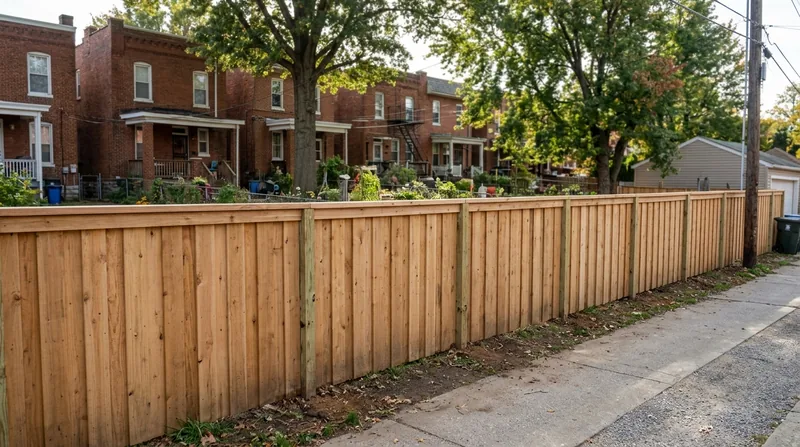




Washington's rowhouse neighborhoods, from Capitol Hill to Chevy Chase, rely on privacy fence installation to define property lines along narrow rear alleys and side yards carved from dense red clay and mature oak. A well-built 6-foot cedar or treated-pine privacy fence withstands the freeze-thaw cycles that heave posts in winter, the humid summers that rot wood at the ground line, and the occasional derecho that drops limbs across panels. We install wood privacy fences with posts set deep in concrete, using cedar for its natural durability or pressure-treated pine for budget-conscious builds, in board-on-board and side-by-side configurations that suit the tight spaces and architectural character of Washington homes. Whether your fence is new construction, a replacement of a failing structure, or a repair to storm damage, we work from your property line and build to code.
Why Privacy Fence Installation Matters in Washington's Dense Urban Neighborhoods
Washington's Victorian rowhouses and brick semis sit close to one another, with backyards opening onto paved alleys and side yards barely wider than a fence panel. A privacy fence is not a luxury, it's the boundary between your space and your neighbor's, and it has to hold against the city's punishing climate. The red clay beneath most Washington homes expands and contracts with seasonal moisture, heaving fence posts upward in spring and leaving them loose by summer. Humidity and ground-line rot are the dominant failure modes here, not insects or drought.
- Pressure-treated posts set in concrete prevent heaving and extend post life to 15 to 20 years, far longer than tamped soil alone.
- Cedar pickets resist rot better than untreated pine, but treated pine offers solid performance at half the cost if your budget is tight.
- Board-on-board construction in Washington's narrow alleys provides privacy from both sides while shedding water and ice more effectively than solid panels.
- Proper spacing and anti-sag bracing hold panels flat through the weight of wet snow and summer humidity.
A properly built privacy fence also respects Washington's zoning and HOA requirements, which vary across neighborhoods, some allow 6 feet, others cap height at 4 feet in front yards, and deed restrictions in master-planned communities often govern material and color.
Key info: Washington's freeze-thaw winters and humid summers create the ideal conditions for post heave and ground-line rot. Posts set in concrete, not tamped soil, stop heaving before it starts. Cedar is beautiful and durable, but treated pine performs nearly as well at a fraction of the cost in DC's climate.
For more on addressing existing fence problems, see our page on fence post repair and replacement.
How We Install Privacy Fences in Washington: Process and Standards
Privacy fence installation in Washington starts with understanding your property line, the setback rules that apply in your neighborhood or HOA, and whether a permit is required. Most Washington jurisdictions require a locate call to 811 before we dig post holes, so we always call first. We then lay out the fence line with string, mark post locations at standard 6-foot intervals, and dig holes to frost depth, typically 36 to 42 inches in Washington, to prevent heaving.
Posts are set in concrete, not tamped soil, and allowed to cure for 48 hours before rails and pickets go up. We use pressure-treated posts rated for ground contact, cedar or treated-pine pickets depending on your budget and preference, and galvanized fasteners that won't rust in Washington's humidity. The fence is built plumb and level, with stringers (horizontal rails) securely attached and pickets spaced evenly, either board-on-board for maximum privacy or side-by-side for a lighter look.
- We verify property lines and setback rules with you before beginning, and confirm permit requirements with the local building department.
- Post holes are dug to frost depth and posts are set in concrete to prevent heaving and rot.
- Rails are attached with galvanized bolts or screws, and pickets are fastened with stainless steel or hot-dipped galvanized nails.
- The fence is built plumb, level, and square, with proper spacing between pickets and no gaps or sags.
- We clean up all debris and haul away old materials if you're replacing an existing fence.
The entire process takes 3 to 5 days for a typical backyard privacy fence, depending on fence length, soil conditions, and whether we're removing an old fence.
Example: A Capitol Hill rowhouse with a 60-foot rear alley fence and existing posts heaving in red clay gets new pressure-treated posts set 42 inches deep in concrete, 6-foot spacing, cedar pickets board-on-board, and galvanized hardware. Total time: 4 days. The fence is built level and plumb, and will hold for 15 to 20 years if posts stay dry at the ground line.
For help with storm damage or existing fence repairs, visit our storm damage fence repair page.
Privacy Fence Installation Methods: Board-on-Board, Side-by-Side, and Stepped Installation
| Approach | Description | Best for |
|---|---|---|
| Board-on-Board | Pickets overlap alternately on front and back, creating privacy from both sides and shedding water more effectively than solid panels. | Washington's narrow alleys, humid summers, and freeze-thaw winters where water management is critical. |
| Side-by-Side | Pickets run vertically and touch edge-to-edge, creating a solid screen with no gaps. Simpler to build and less expensive than board-on-board. | Budget-conscious installations, dog runs, and properties where water shedding is less of a concern. |
| Stepped Installation | Posts and rails step down to follow sloped terrain rather than racking (angling) the panels, keeping pickets plumb and the fence looking built-to-grade. | Washington's gently rolling lots in neighborhoods like Chevy Chase, Spring Valley, and the Palisades where uneven terrain is common. |
| Cedar vs. Treated Pine | Cedar has natural rot resistance and ages to a silver-grey; treated pine is pressure-treated to resist rot and costs 40 to 50 percent less. | Cedar for premium aesthetics and longevity; treated pine for budget builds and situations where appearance is secondary to function. |
Wood and Privacy Fence Installation Cost in Washington: What to Expect
Privacy fence installation costs in Washington typically run from $27 per linear foot for treated pine, side-by-side construction with standard post spacing, up to $45 to $55 per linear foot for cedar board-on-board with premium finishes. A 60-foot fence, typical for a Washington rowhouse rear alley, falls in the $1,600 to $3,300 range depending on material choice, construction method, and site conditions. Several factors move the price within that range: soil type and compaction (red clay is harder to dig), existing fence removal, tree roots or underground utilities in the post-hole path, and slope requiring stepped rather than racked installation.
We always recommend getting 2 to 3 estimates before deciding. A low bid may reflect faster work or lower-cost materials; a high bid may include site preparation, premium cedar, or extra anti-sag bracing that adds years to the fence's life. The best estimate is the one that explains what you're paying for and why.
For a detailed pricing breakdown and current rates, visit our full pricing page.
What to Look for When Hiring a Fence Contractor Near Washington
Hiring a fence contractor in Washington means checking insurance coverage, understanding how fence permitting works in your specific neighborhood or HOA, and verifying that the contractor has experience with Washington's red clay, freeze-thaw winters, and humidity. Fence work in Washington is not uniformly licensed across all jurisdictions, rules vary by county and municipality, so confirm with your local building department whether a permit is required and whether any contractor licensing applies to your job scope. What matters most is that your contractor carries full liability and workers' compensation insurance, provides a certificate of insurance on request, and has a clear track record in your neighborhood.
Ask for references from homeowners in Capitol Hill, Petworth, Bloomingdale, or wherever your home is located. Walk past a finished fence if you can. Verify that the contractor understands HOA rules if your property is in a master-planned community, many Washington neighborhoods have strict height, material, and color restrictions that must be approved before work begins. Confirm that a 811 utility locate will be called before post holes are dug, and that the contractor respects any protected or heritage trees on your property.
- Verify that the contractor carries full liability insurance and workers' compensation coverage, with a certificate of insurance available on request.
- Ask for local references and walk past finished work to see quality and attention to detail.
- Confirm that the contractor understands HOA architectural standards and will submit plans for approval if required.
- Check that a 811 utility locate will be called before digging, and that the contractor respects any easements or protected trees on your property.
- Get a written estimate that breaks down material, labor, and any site-specific costs, and ask why the price is what it is.
- Verify the timeline and ask what happens if weather delays the job or if unexpected soil conditions are found during installation.
For a free, no-obligation estimate from a contractor with deep roots in Washington neighborhoods, contact us today or call (771) 246-2846.
Wood & Privacy Fence Installation in Washington: Pricing Guide
| Service | Price | Details |
|---|---|---|
| Treated Pine Privacy Fence, Side-by-Side | Starting at $27/ft | Pressure-treated posts set in concrete, treated pine pickets, standard 6-foot spacing, includes removal of old fence if present |
| Cedar Privacy Fence, Board-on-Board | Starting at $45/ft | Pressure-treated posts in concrete, clear cedar pickets, board-on-board construction, galvanized hardware, stepped installation on sloped terrain included |
| Stepped Installation on Sloped Lots | $8 to $12/ft premium | Posts and rails step down to follow terrain rather than racking panels, keeping pickets plumb and fence level with grade |
| Existing Fence Removal and Haul-Away | $4 to $8/ft | Removal of old fence, posts extracted, all debris hauled away, site cleaned and ready for new installation |
| Travel and Site Visit | Included | No mileage fee or separate call-out charge for estimates and installations anywhere in Washington and surrounding areas |
| Free Estimate | No charge, no obligation | Response within 24 hours at (771) 246-2846, on-site assessment of soil, terrain, utilities, and property line included |
Indicative pricing, the exact cost depends on square footage, finish, and site access. Free personalized estimate within 24h at (771) 246-2846.


