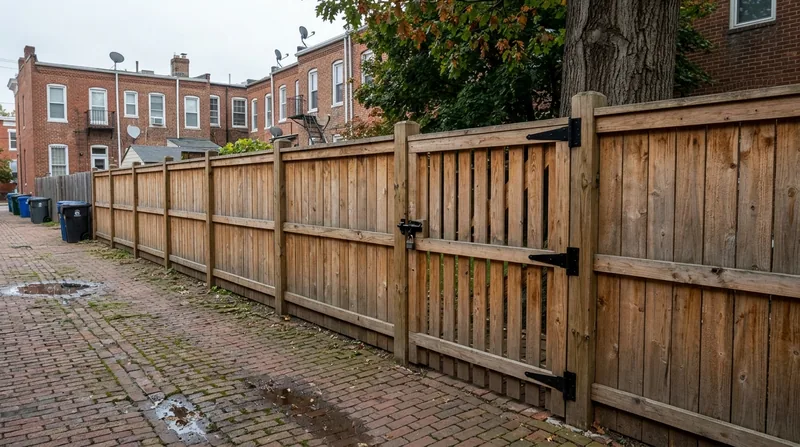




Washington's dense historic neighborhoods, from Capitol Hill's narrow brick rowhouses to the tree-lined streets of Cleveland Park and the Palisades, rely on fences and gates to define property lines and secure yards. The region's freeze-thaw winters, humid summers, and heavy red clay soil take their toll fastest on gates, which swing open and closed thousands of times a year while bearing the full weight of seasonal movement and weather stress. A sagging gate or one that binds in its frame is often the first sign that posts are heaving, hinges are wearing, or rot is starting at the ground line. Gate installation and repair in Washington demands both precision carpentry and an honest read of what can be fixed versus what should be replaced. We build gates square, hang them right, and rebuild alley gates that drag or bind after a wet winter, usually the first part of any fence to fail.
Why Gates Fail Fast in Washington's Climate
Washington's winters cycle above and below freezing, heaving posts upward and tilting gate frames out of square. Spring thaw leaves the soil saturated, rotting the base of wooden posts where they meet the ground. Summer heat and humidity swell wood unevenly, binding gates in their frames. Fall storms and winter derechos drop branches onto gates and bend hinges. Alley gates, which open onto paved rear lanes behind rowhouses on Capitol Hill, Bloomingdale, and Petworth, take the worst punishment: they swing between two fence lines, support the weight of privacy boards, and often sit in standing water after heavy rain.
- Posts set in clay soil shift and heave as moisture freezes and thaws, tilting the gate out of plumb.
- Untreated or pressure-treated wood rots at the ground line within 5 to 10 years if posts are not set in concrete or replaced before the rot spreads.
- Hinges and hardware corrode from salt spray and humidity, causing gates to sag or bind.
- Gate frames twisted by frost heave bind against the fence line or hang crooked, making them hard to open and close.
Fixing a sagging gate early saves the cost of a full replacement and keeps your fence line secure through the next winter.
Key info: Alley gates in Washington neighborhoods like Shaw and Petworth fail faster than front gates because they sit lower, hold standing water longer, and see more foot traffic. A gate that drags in spring after a heavy winter often needs new posts set deeper in concrete and anti-sag bracing, not just hinge adjustment.
For more on how moisture damages wood at the ground line, see our fence post repair and replacement guide.
How We Install and Repair Gates in Washington
A proper gate starts with posts set in concrete, spaced to match your fence line and set plumb (perfectly vertical). We build the frame from pressure-treated pine or cedar, depending on your fence material, and hang it on adjustable hinges so it can be fine-tuned after installation. Self-latching hardware keeps the gate closed without a lock, and anti-sag bracing (diagonal or cross-bracing) prevents the frame from racking as wood moves with seasonal moisture. For repairs, we first diagnose whether the gate itself is twisted beyond correction or whether the posts have heaved and need reset.
- Locate existing fence posts or set new ones in concrete at 36 to 48 inches below grade, depending on soil and frost depth.
- Build the gate frame square on the ground, checking diagonals to ensure corners are true right angles.
- Attach horizontal rails (stringers) and vertical pickets or boards, then install anti-sag bracing if the gate is over 3 feet wide or 5 feet tall.
- Hang the gate on adjustable hinges and install self-closing and self-latching hardware, then adjust hinges until the gate swings freely and latches without binding.
- Set the gate to close cleanly and latch smoothly, with no drag or rattle.
Once installed, a well-hung gate needs little maintenance beyond periodic hinge adjustment and hardware replacement as corrosion sets in.
Local example: A homeowner in Cleveland Park had a 4-foot cedar privacy gate that sagged after three winters. We reset both posts in concrete 48 inches deep, rebuilt the frame with cross-bracing, and rehung it on stainless steel hinges. Five years later it still swings without binding. The deeper set and the bracing absorbed the frost heave that had twisted the old frame.
Read more about wood privacy fence installation to understand how gate material choices affect durability.
Gate Installation and Repair Methods: Wood, Vinyl, and Metal
| Approach | Description | Best for |
|---|---|---|
| Wooden privacy gate (cedar or pressure-treated pine) | Frame and boards built to match existing fence, posts set in concrete, anti-sag bracing on wide or tall gates, stainless or galvanized hardware. | Alley gates, backyard privacy gates in rowhouses and detached homes, replacement of rotted gates. |
| Vinyl gate (PVC or composite) | Vinyl panels and rails assembled on aluminum or steel frame, no painting needed, rot-proof, lighter than wood so hinges carry less stress. | Gates paired with vinyl fencing, low-maintenance applications, coastal or high-moisture areas. |
| Ornamental metal gate (wrought iron or aluminum) | Steel or aluminum frame with vertical pickets, welded and powder-coated or painted, often custom-built, very durable but heavier and requires periodic paint touch-up. | Front-yard gates on rowhouses, formal entrances, high-security applications, gates that see salt spray or harsh weather. |
| Gate repair (sagging, binding, or hinge replacement) | Diagnose root cause, reset posts if heaved, replace hinges or hardware, rebuild frame if twisted, add bracing to prevent future sag. | Gates that drag or bind, hinges that are corroded, gates that have shifted with frost heave or settling. |
| Automatic or driveway gate (cantilever or V-track) | Heavy-duty frame, gate operator motor, safety sensors, remote or keypad control, tracks or hinges rated for frequent use. | Driveway gates, high-traffic entrances, security gates, properties where manual operation is impractical. |
Gate Installation and Repair Cost in Washington: What to Expect
Gate installation and repair costs in Washington depend on the size of the gate, the material (wood, vinyl, or metal), whether posts need to be reset, and whether the job is new construction or a repair. A standard 4-foot-wide wooden privacy gate hung on existing posts starts at around $475 to $650, while a full gate installation with new posts set in concrete and anti-sag bracing runs $800 to $1,200. Vinyl or ornamental metal gates cost more upfront but last longer and need less maintenance. Gate repair (hinge replacement, frame rebuilding, or post reset) typically runs $300 to $600, depending on what's wrong.
Factors that move the price up include the width and height of the gate (wider gates need heavier frames and bracing), whether posts are heaved or rotted and need replacement, the material (pressure-treated pine is cheapest, cedar is mid-range, vinyl and metal are premium), proximity to structures or utilities that complicate digging, and whether you need permits or a utility locate (required by law in Washington before digging post holes). Getting 2 to 3 estimates from local contractors helps you understand what's included at each price point and whether a repair or replacement makes sense for your fence.
For a detailed breakdown of our pricing by service and material, see our full pricing guide.
What to Look for When Hiring a Fence Gate Contractor Near Me in Washington
Hiring a fence contractor near you in Washington means finding someone who understands local soil conditions, seasonal weather stress, and the specific fence styles that fit your neighborhood, whether that's a wrought iron front gate on a Capitol Hill rowhouse or an alley gate behind a Petworth brick semi-detached. Look for a contractor who is fully insured with general liability and workers' compensation coverage and can provide a certificate of insurance on request. Ask how fence licensing works in your jurisdiction, because rules vary across Washington neighborhoods and HOA communities. Some properties require permits, especially if the gate is in a front setback or a heritage district; your contractor should know the rules for your address and advise you on what the local building department requires.
Check references from recent gate installations and repairs, and ask to see photos of work in your neighborhood or similar conditions. Get 2 to 3 written estimates that break down labor, materials, and whether posts are being set in concrete or tamped (concrete is better in Washington's clay and freeze-thaw cycle). Ask whether the contractor will do a free utility locate call to mark underground lines before digging post holes, as Washington law requires it. If you live in an HOA community or a protected historic district, confirm that your gate material and color meet architectural standards before ordering materials.
Call us at (771) 246-2846 for a free estimate and to discuss what's right for your gate and fence. We can walk you through local permitting, HOA requirements, and whether your existing gate can be repaired or should be replaced. Contact us online or request an estimate with no obligation.
Gate Installation & Repair in Washington: Pricing Guide
| Service | Price | Details |
|---|---|---|
| Wooden privacy gate (4 ft wide, existing posts) | Starting at $475 | Single-swing gate with frame and boards, installed on existing posts with adjustable hinges and self-latching hardware |
| Wooden gate with new posts and anti-sag bracing | Starting at $800 | Full installation including posts set in concrete 48 inches deep, frame, boards, cross-bracing, and hardware for wider or taller gates |
| Gate repair (sagging, binding, hinge replacement, or post reset) | Starting at $300 | Diagnosis and repair of existing gates, including hinge adjustment, hardware replacement, frame rebuilding, or post reset depending on damage |
| Vinyl or ornamental metal gate installation | Starting at $1,200 | Premium materials with new posts, frame, and hardware, lasting longer and requiring less maintenance than wood in Washington's wet climate |
| Automatic or driveway gate (cantilever or V-track) | On estimate | Heavy-duty installation with operator motor, safety sensors, remote control, and track or hinge rated for frequent use requires on-site assessment |
| Free estimate and utility locate | Included | No obligation, response within 24 hours at (771) 246-2846, utility marking before digging required by Washington law |
Indicative pricing, the exact cost depends on square footage, finish, and site access. Free personalized estimate within 24h at (771) 246-2846.


